Token Audit and Security
Info
Watch the video tutorial for a practical example of how to analyze a token.
Wenshot helps you verify a token’s security by automatically analyzing its smart contract directly on the blockchain. This allows you to identify potential risks before trading.
When viewing a token, scroll down to access the main due-diligence sections: Audit, Contract Info, Owner Info, and Methods.
1. Audit Overview
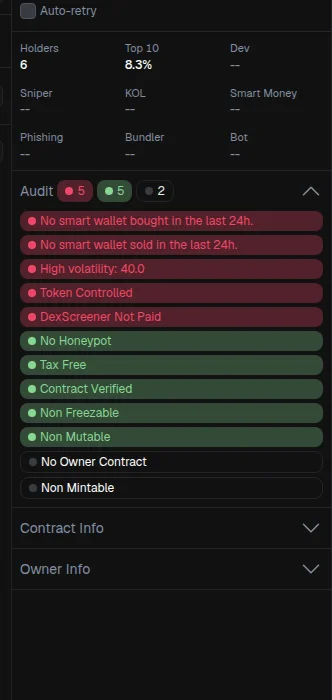
Wenshot runs automated checks to highlight risky, safe, or neutral behaviors.
The most important checks include:
- Honeypot test: simulates a buy and a sell; if selling fails, the token is flagged
- Taxes: shows whether a fee is applied on buys or sells
- Renounced contract: indicates the developer can no longer modify the contract (usually positive)
- Volatility: which means the price is moving rapidly with large spikes and drops. Volatility values around 1–3 are generally stable, while 20–100+ indicate very high risk
- DEXscreener paid badge: shows marketing investment by the team
- Verified contract: source code is published and verified on a blockchain explorer
- Not mintable: confirms that new tokens cannot be created arbitrarily
2. Contract Information
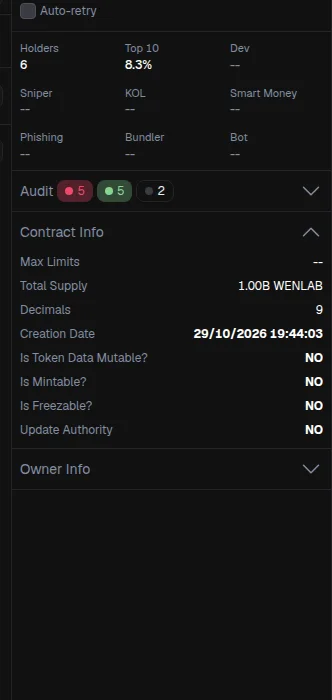
This section shows key parameters that explain how the token behaves:
- Buy and sell taxes: fees taken on each trade
- Wallet limits: restrictions on how much a wallet can buy, sell, or hold (extreme limits are a red flag)
- Total supply: total number of tokens in circulation
- Token decimals
- Creation date: when the token was first deployed on-chain
3. Owner and Creator Info
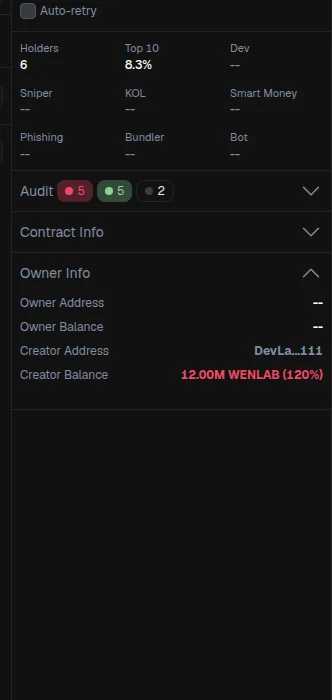
If a contract is renounced, ownership is usually transferred to a burn address, meaning there is no active owner. You can also inspect the creator wallet to look for suspicious patterns or behavior.
4. Methods
This section lists the functions included in the smart contract. It is mainly intended for advanced users, but you can click through to a blockchain explorer to inspect the contract code directly.
Danger
Important Note No automated audit can guarantee 100% safety. Smart contracts can be written in many ways, and malicious logic is not always obvious. Always combine Wenshot’s analysis with other tools such as Token Sniffer or DEXscreener contract checks.
Additional Manual Checks
Beyond the contract, always review:
- Social presence: verify activity on X (Twitter), Telegram, websites, or GitHub
- Smart wallet activity: if smart wallets can buy and sell successfully, the token is likely not a honeypot
- Volume vs. liquidity: very high volume with very low liquidity may indicate fake activity
- Chart patterns: staircase pumps, repeated buy-sell patterns, or sharp pumps followed by immediate crashes
These behaviors often indicate artificial volume or potential rug-pull risk.